* MUNDANE ASTROLOGER THEODORE WHITE FORECASTS ON WORLD EVENTS* 21ST CENTURY ASTROLOGY * FORECASTS ON WEATHER THAT'S OUTER & INNER PLANE... NEWS * ASTROPHYSICAL * GEOPHYSICAL * TRANSITS * CURRENT EVENTS * SIGNS * THE FUTURE * MUNDANE FORECASTS * ASTRONOMY * ASTROJOURNALISM * ECONOMICS * MYSTERIES * PROPHECY * NATAL ASTROLOGY * ASTROTHEOLOGY * GNOSIS * SCIENCE * WISDOM * AND PRACTICAL COMMONSENSE AS GLOBAL EVENTS APPLY TO THE WHOLE AND NOT SIMPLY TO THE SUM OF ITS OWN PARTS.

Search Global Astrology Topics

Showing posts with label storms. Show all posts

Wednesday, October 16, 2024

GLOBAL ASTROLOGY - Signs of The Times: Giant Perigee October 2024 SuperMoon & Sunset Comet Seen Worldwide >> Also, Refresh & Get Ready For 2025: Into The Mid-2020s >> Plus, Bright Comet Tsuchinshan-ATLAS Races Across Earth’s Skies >> Caution for Earthquakes & More Storms

 Signs of The Times:
October 2024 - March 2025


Giant Perigee October 2024 SuperMoon To Be Seen Worldwide


Also,

Bright Comet Races Across Earth’s Skies


Refresh & Get Ready For 2025:
'Into The Mid-2020s'


GLOBAL ASTROLOGY


by Theodore White, mundane Astrolog.sci

‘They saw the stars their constant round mountains,

Perform their course, and then return again. They, on their aspects saw the Fates attend.

Their change on their variety depend,

And thence they fixed unalterable laws,

Settling the same effect on the same cause.” 

~ mundane astrologer Marcus Manilius


by Theodore White, mundane Astrolog.sci

The times we currently experience in 2024 have been full of presages and celestial events all year. 

From major planetary conjunctions to a season of solar and lunar eclipses, what we have witnessed so far to date in 2024 call for strict attention going into next year of 2025.

On October 16-17, there is a perigee 'supermoon' on tap.

On Wednesday night, Oct. 16th, the Moon, in tropical Aries, will be very close to, or already at perigee, but it will also be closer to the time when it actually turns full on Thursday morning, October 17th.

So, if you want to get a full "supermoon effect," then Wednesday evening is your night. 


I also continue to warn on flurries of earthquakes under the current planetary era we are now and caution to have emergency preparedness plans updated ad supplies refreshed through the remainder of 2024.

All of this year, from geophysical, geopolitical and metaphysical events, from war, to famine, to powerful storms, hurricanes, tornadoes, torrential rains and floods, the events of 2024 that have changed and altered the lives of tens of thousands of people, yea, even millions globally – speak to the significance of the signs of the times.

One commenter on 2024's events writes:

"This is an exceptionally turbulent and dangerous period we’re living in these days. 

Hurricanes Helene and Milton come and go, leaving terror, death and calamitous destruction in their wake.

A one-year-old war continues to rage on the two of Israel’s three land borders, threatening to expand into a regional conflict pitting Israel against Iran with Syria, Iraq and the Gulf States potentially getting pulled in also.

In Eastern Europe, a now 30-month-old war continues as neither Russia nor Ukraine sees its objectives achieved with any current ceasefire proposals.

The United States is at the center of all of it. Places like Asheville, North Carolina and Tampa Bay, Florida, comparatively unscathed by hurricanes for a century, have been clobbered just in the last month.

Were it not for the consistent and largely unconditional support of the US for the past 76 years since its post-World War II creation as the world’s Jewish state, Israel, might well have disappeared decades ago. And American military support continues to prop up the beleaguered Kyiv regime of Ukrainian president Vladimir Zelensky."

Indeed, as we near the change of the North Lunar Node in January 2025, and the coming conjunction of Saturn and Neptune near the Vernal Equinox point all through next year it also appears that the global economy is entering a "dangerous time" like never before as Middle East tensions remain elevated, according to S&P Global's vice chairman Daniel Yergin:

"Since the Israel-Hamas conflict began on 7 October 2023, the oil market has experienced minimal disruptions, with prices remaining under pressure as a result of increased U.S. production and weak demand from China.

However, this sentiment has been shifting.

Oil prices spiked the first week of October 2024 on fears that Israel could target Iran's oil industry in retaliation for Tehran's ballistic missile attack, with industry analysts raising concerns about a genuine threat to supply.


The Israelis have not concluded what they're going to do in terms of a strike - that's under discussion," said U.S. President Joe Biden, who told reporters at a White House press briefing last week that he discouraged Israel from striking Iranian oil facilities.

Last week, both oil benchmarks saw their biggest weekly gain since March 2023.

During Asia trading on Tuesday, global benchmark Brent slipped 1.77% to $79.50 a barrel, while U.S. West Texas Intermediate traded 1.83% lower at $75.77 per barrel.

Yergin told CNBC that he expects Israeli retaliation will not just be a replay of last April, but something "much stronger."

In April, Iran and Israel came to blows but ultimately avoided a full-scale war. Iran fired hundreds of ballistic missiles and drones at Israel in retaliation for an attack on an Iranian diplomatic facility in Syria.

When asked if the global economy is on the precipice of another supply shock resulting from Middle East tensions, Yergin said it's a precarious time for markets.

"I think it's a very dangerous time, one that we haven't seen," he said. 

Additionally, while Yergin maintained that it is not certain whether Iranians have operational nuclear weapons, that is still "certainly in the backdrop," particularly through the lens of the Israelis.

"The betting is that the Israelis would not attack, try to attack, the nuclear facilities at this time.

But a few months from now, a few weeks from now, whatever it is, Iran would have the capacity - it's thought - to deliver a nuclear weapon, and that raises the stakes," he said, likening the moment to the 1962 Cuban Missile Crisis.

That said, Israel is a lot more concerned about Iran's nuclear facilities than the Iranian oil industry, said Pavel Molchanov, managing director of investment services firm Raymond James.

Iran's nuclear program has progressed to a stage where, in approximately one week, the country could potentially enrich enough uranium for five fission weapons, according to estimates by Iran Watch, a website published by the Wisconsin Project on Nuclear Arms Control.

"The worst-case scenario would be something that Iran can do on its own, which is a blockade of the Strait of Hormuz. So this is not directly related to Israeli airstrikes or missiles. 

The strait, between Oman and Iran, is a vital channel where about one-fifth of global oil production flows daily, according to the U.S. Energy Information Administration.

It is a strategically important waterway linking crude producers in the Middle East with key markets across the world.

The inability of oil to traverse through the strait, even temporarily, can increase shipping costs, lead to considerable supply delays and ratchet up global energy prices, with some surmising that a worst-case scenario could prompt oil prices to surge above $100 a barrel."

Going into 2025 it will be necessary for the good reader to have a good outline of how to meet your goals and obligations enough to minimize the continued onslaught of international and global events into your lifestyle.

Judicial, or Mundane Astrology relates to forecasts on general events globally, regional, internationally and locally.

It concerns itself with the rise and fall of empires, revolutions, conflicts, wars; as well as kings, queens, nations and their leaders and with astrometeorology, the weather and climate, droughts, floods, famine, the atmosphere, as well as pestilence and famine.

A.J. Pearce writes that, “There is no question that mundane astrology was based upon the results of a centuries’ long series of observations, as Manilius avers, the inductive method being followed in reducing it to a science.”

This present era, October 2024, call for prudence, patience, and planning into the 2025 that is just ahead.


Refresh & Get Ready For 2025
Into The Mid-2020s


The Millennial Generation, those born 1981-1995, are now in their 30s and early 40s going into the new solar year of 2025 - a major year worldwide.

Facing life going into their middle age years, this generation will be tasked with finding themselves as an already fast-paced world gets even faster and more complex as the midway point of the 2020s arrives.

Into the common year of 2025, the last remaining significant of this 2024 are those that bring to end the issues that have been ongoing since July 2023. 

Here are the remaining world transits of Common Year 2024:

*Red color indicates strong global influence*

· October 12, 2024 – PLUTO DIRECT AT 29-CAPRICORN

·        November 15, 2024 – SATURN DIRECT AT 12-PISCES

·        November 26, 2024 – MERCURY RETROGRADE AT 22-SAGITTARIUS


·        December 6, 2024 – MARS RETROGRADE AT 6-LEO (until February 23-24, 2025)

·        December 7, 2024 – NEPTUNE DIRECT AT 27-PISCES

·        December 13, 2024 – JUPITER SESQUI QUADRATE PLUTO

·        December 15, 2024 – MERCURY DIRECT AT 6-SAGITTARIUS

·        December 24, 2024 – JUPITER SQUARE SATURN (2nd of 3 world squares)

The transits of October, November and December 2024 are calling for attention to the future as the Lunar Nodes are winding down their presence on the Aries-Libra axis where they have been since July 2023.

These wind-down months of the Lunar Nodes - October, November and December 2024 - can be applied very well, that is, if you are not distracted by events and the upcoming holiday season as many will be.

Those who have experienced natural disasters, such as the recent hurricanes, storms, floods and wind damage and lost homes and properties are already looking ahead to the future as they recover.

The recovery will go well for many, so, by the time of June, July and August 2025, new lives will begin to get underway.

The entry into the middle years of the 2020s require that individuals and their families know their own nativities (horoscopes) their Transits, Secondary Progressions and Solar Returns.

Those reaching the ages of 28-30, 34-36, 43-45, 53-57, 75-77, will want to know what 2025 holds for them in changes as the world enters the mid-2020s. 


My analysis of the planetary transits of  the common year 2025 hold significant importance for a great many people worldwide.

According to my calculations, 2025 will be a major year of events, and also include bright futures for those who us the planetary transits well in their lives so as to successfully meet their aspirations, goals and plans.

Here are the major world transits of Common Year 2025:

*Red color indicates strong global influence*

·  11 January 2025 - LUNAR NODES ENTER PISCES-VIRGO AXIS

·  January 26, 2025 – SATURN SEMI SQUARE PLUTO (3rd exact world semi square)

·        January 30, 2025 – VENUS HEADS NORTH IN DECLINATION

·       January 30, 2025 – URANUS STATIONS DIRECT AT 23-TAURUS


·       February 4, 2025 – JUPITER STATIONS DIRECT AT 11-GEMINI

February 4, 2025 - VENUS ENTERS 0-ARIES

·        February 24, 2025 – MARS STATIONS DIRECT AT 17-CANCER


·       March 2, 2025 – MERCURY TURNS NORTH IN DECLINATION

·      March 2, 2025 – VENUS RETROGRADE AT 10-ARIES

·  March 14, 2025 - LUNAR ECLIPSE at 23-24 VIRGO


·        March 15, 2025 – MERCURY STATIONS RETROGRADE AT 9-ARIES

· 20 MARCH 2025 - VERNAL EQUINOX - SUN ENTERS 0-ARIES

·  March 29, 2025 - PARTIAL SOLAR ECLIPSE AT 9-ARIES

· 22 MARCH 2025 - VENUS TURNS MORNING STAR

·  30 March 2025 - NEPTUNE ENTERS TROPICAL ARIES


·        April 3, 2025 – MERCURY TURNS SOUTH IN DECLINATION

 April 4, 2025 – SATURN SEXTILE URANUS - 1st of three sextile aspects)

·        April 7, 2025 – MERCURY STATIONS DIRECT AT 26-PISCES

·        April 13, 2025 – VENUS STATIONS DIRECT AT 24-PISCES

·  30 APRIL 2025 - VENUS RE-ENTERS O-ARIES
 

·        April 17, 2025 – JUPITER SESQUI QUADRATE PLUTO

·        April 23, 2025 – MERCURY TURNS NORTH IN DECLINATION

·        May 4, 2025 – PLUTO STATIONS RETROGRADE AT 3-AQUARIUS

25 MAY 2025 - SATURN ENTERS TROPICAL ARIES

·        June 4, 2025 – JUPITER SEMI-SEXTILE URANUS

·  9 JUNE 2025 - JUPITER ENTERS TROPICAL CANCER


·        June 15, 2025 – JUPITER SQUARE SATURN (3rd and final world square)

·        June 19, 2025 – JUPITER SQUARE NEPTUNE

·        June 24, 2025 – JUPITER QUINCUNX PLUTO

4 July 2025 - NEPTUNE STATIONS RETROGRADE at 2-ARIES

12-13 July 2025 - SATURN STATIONS RETROGRADE at 1-ARIES

These major transits through to July 2025 will be of notable interest to the good reader as the entry indicates it will be a major year for a great many people worldwide.

The year itself opens in a manner that brings to an end most matters that governed the first four years since the historic Jupiter-Saturn conjunction that began in December 2020. 

Since the COVID-19 pandemic that also began in 2020, most people have had to seriously adjust their domestic and working lifestyles during and after the pandemic; sparking significant changes for populations worldwide.

As solar year 2024 comes to an end, the planetary transits of 2025 and the mid-2020s can offer you very positive changes, if you are conscious and willing to map a course personalized for you and your family going into the middle to latter years of this decade.

Your goals, thoughts, aspirations and planning will determine how you will successfully meet your wants, needs and desires throughout the mid-to-late 2020s.

It will also determine how you will be able to successfully navigate into the early-to-mid 2030s. 

If you want to know what your personalized transits, progressions and returns hold for you in 2025, you can contact me at astro730@gmail.com

When you write, please include your birthday, time and place of birth. Also include your current geographic region if different from your city/town of birthday.

Briefly comment on your current situations, as well as your aspirations, goals and plans for 2025.

Meanwhile, the third of four 'Supermoons' is about to get underway in mid-October and it will be the biggest supermoon of 2024 just as a comet races across Earth's skies.


Giant Perigee October 2024 SuperMoon To Be Seen Worldwide


by Theodore White, mundane Astrolog.sci

On Thursday, October 17th, the biggest Full Moon of 2024 will occur at 24-25 degrees of tropical Aries.

This ‘Hunter’s Moon,’ is also a Supermoon, and those who want to take a look will witness a giant Moon at 'perigee,' closest to the Earth. 

The Moon will look 10% larger than it normal does to the observer.

October's full moon will be visible waxing to its full lunar phase before the Sun rises on Thursday, Oct. 17th and due to its proximity to Earth, the Moon will appear to be already full in the days before.

On Thursday (Oct. 17) at 7:26 a.m. EDT (1126 GMT), the Aries Moon will officially turn full.

But less than 11 hours earlier, at 8:48 p.m. EDT on Wednesday night, Oct. 16th, the Moon will have arrived at perigee, its closest point to Earth at a distance of 221,938 miles (357,174 km) away. 


This Hunter's full moon is the third of four perigee ‘supermoons’ this year, as the fourth and final one will begin on November 15, 2024.

October's perigee Moon to the Earth will be the biggest supermoon of 2024 as its entire surface facing us is illuminated by the Sun. 

Amid the perigee Moon there is also the sight of Comet C/2023 A3 (Tsuchinshan-ATLAS) - called by some 'the comet of the century. It will still be visible just as the Sun sets in the west. More on that later.

On average, Supermoons will appear to be about seven percent larger and about 15% brighter than a typical full moon.

click on graphic to enlarge

The graphic above depict the line that connects the Moon's perigee with lunar apogee defines the Moon’s major axis, which is the longest axis of an ellipse.

When the Moon’s major axis - or apogee-perigee line - points toward the Sun (A and C on the diagram) - the eccentricity (or flatness) of the Moon’s orbit is increased to a maximum.

A greater eccentricity will lessen the perigee distance, but increases the apogee distance.

At 'A' in the drawing, it is a 'perigee' new Moon (supermoon) and an apogee full moon, or, what is called technically a 'micro-moon.'

Then, some 3.5 lunar months (which is 103 days) later, at 'B' in the diagram, the major axis is at a right angle to the sun-Earth line, so the eccentricity of the Moon’s orbit is minimal.

click on graphic to enlarge

At this time, the Moon’s orbit is more circular.

It’s a distant perigee and a 'closer' apogee, with the first quarter and last quarter Moons more or less aligned with apogee and perigee.

Then seven (7) lunar months (206 days) later, the major axis again points sunward.

Once again, the eccentricity of the Moon’s orbit is increased to a maximum, lessening the perigee distance yet increasing the apogee distance.

But this time, it is a 'full' Moon perigee.

Compared to the Moon at its faintest, a 'Supermoon' is about 14% larger and 30% brighter.


If you are a stargazer as I am, then you will be able to enjoy the Moon’s peak illumination on Thursday, October 17th just before the Moon sets in the western skies as the Sun rises in the east. 

The Moon will still appear to be quite large, nearly full, after the exact Moon-Sun axis is perfected between 7-9 a.m. ET on Thursday morning, October 17th and will appear to remain full for about another two or so days because of its perigee closeness to Earth.

Between October 14 through Oct. 21st, from 7:30 p.m. through to 4:30 a.m., you can see the constellations and stars of Pisces, Aries, Taurus and Gemini rising after midnight in the eastern skies, the Ascendant.

If you stay up throughout the night, then with clear skies, you will also be able to see transiting Saturn, Jupiter and Mars, along with the transiting Moon during that week of October.


‘GEOPHYSICAL & METAPHYSICAL EFFECTS’

As the good reader who follows my forecasts already know, the geophysical impacts of a perigee ‘supermoon’ can be quite impressive with effects on powerful storms even before the full lunar phase is perfected.

During this time into mid-October, as you read this, you may find interesting news events on earthquakes. Look for them and post them in the comment section if you would like.

For months, I have been forecasting and warning on powerful storms, floods, adverse weather, along with seismic activity of earthquakes and volcanic eruptions, so if you see, hear, or experience them, let us know.

The before and aftereffects of a perigee Moon always must be kept in mind by the astrometeorologists when determining the strength and direction of storms.

Consider hurricanes Helene and Milton over the United States in during these spates of perigee Moon and you will see what I mean with their devastating consequences for life and property.

Even in Nigeria, the tremors being felt are cause for alarm there.

The Moon is the closest planetary body to the Earth and so the Moon also produces the largest gravitational force on the Earth.

There are even moonquakes that take place on the Moon itself. Those are primarily governed by the Earth’s position’ - especially when Moon is at perigee, as it will be in mid-October 2024.

As an Astromet, I have found that seismic activity, in the for of earthquakes and even volcanic eruptions can increase steadily from the Moon’s apogee to perigee relative to the Earth.

The Moon’s transits from the ascending nodes can be used to predict earthquake patterns. I have done this for years, numerous times.

In doing so, I have found that major earthquakes happen more in number when a perigee occurs with a Full Moon and a New Moon than when the Moon is at apogee with similar planetary and solar configurations.


But during the waning phase, the transition from Full Moon to the New Moon, the number of quakes gradually reduces as the Moon reaches its third quarter as events of earthquakes usually is in relation to the variations of tidal forming effects from the Sun and Moon.

There are exceptions of course, as any adverse and hard planetary configurations can spark significant seismic activity.

I have found that it is when the Moon is at perigee that there are more earthquakes felt and reported worldwide than they are when the Moon is at apogee.

Of course, as during my training in the GEM method of my tutor Charles Jayne and the works of L. Edward Johndro on astrological influences by means of transfers of light and especially electricity and magnetism - it can be concluded that at the Moon’s perigee, due to higher gravitational force, we have more earthquakes.

When earthquakes worldwide trigger, they often are aligned from new moon to full moon, as there are increasing earthquake events until full moon.

At perigee-New Moon there are more earthquakes than at the perigee Full -Moon phase.

The reason is because at the perigee-New Moon the Sun is behind Moon and so the combined force doubly acts in the same direction.

Effects on humans by the Moon are well known

According to the New Scientist piece from 2020:

"In February 1954, biologist Frank Brown discovered something that made no sense.

While investigating whether oysters can keep time, he had found that they open their shells to feed at high tide, roughly twice a day.

Brown had a hunch they weren’t simply responding to changes in their environment but would continue the rhythm even if moved far from the sea.

To find out, he shipped a batch of oysters from the ocean off New Haven, Connecticut, hundreds of kilometres inland to Northwestern University in Evanston, Illinois.

Brown kept the shellfish in a sealed darkroom, shielded from changes in temperature, pressure, water currents and light.

At first, the oysters kept their rhythm, feeding each day in time with the New Haven tides.

Then, something strange happened – their feeding times gradually shifted until they lagged 3 hours behind.

Brown was mystified, until he realized that they had adapted to the local state of the Moon: they were feeding at times when Evanston, if it were by the sea, would experience high tide.

Despite having no obvious environmental cues, it seemed these shellfish were somehow tracking lunar cycles."

Brown became convinced that oysters, humans and all life forms are plugged into subtle cosmic cues, continuously sensing both lunar and solar movements to coordinate biological processes, from metabolism to reproduction.

But his ideas seemed outlandish to his peers.

Brown’s results were forgotten, and the notion of lunar influences was dismissed as pseudoscience which is a term that those who are uneducated use when they do not understand something that they themselves never studied or applied themselves to understand.

Anyhow, growing evidence from a range of scientific fields suggested that Brown might have been correct.

Though unusual to those calling it a 'pseudoscience' of the many dramatic influences that the Moon might have on animal biology and human biology - science has proven it to be true.

For instance, a seabird known as Barau's Petrel synchronizes its breeding schedule so that it will arrive to mate on a Full Moon.

Dung beetles have been repeatedly observed in using the Moon to make sure they move their meals in a straight line.

Crustaceans known as sand hoppers have a Moon compass in their antennae so they'll know when to stay buried.

The coral polyps in the Great Barrier Reef start their mass spawning according to the Moon's cycles.

Perhaps, hidden beneath our more obvious earthly rhythms, we are also creatures of the Moon.

The Moon has a significant influence on Earth.


Every month, 'spring' tides occur when the Moon is full and new.

Now, the word 'spring' comes from the German word 'springen' that is, to 'spring up,' and is not a reference to the spring season.

Anyhow, during these times of 'spring tides' the Moon and Sun form a line with the Earth, and their tidal effects combine together. The Sun produces a little less than half of the tidal force of the Moon.


In Astrometeorology, what are called 'neap" tides', are when the Moon is at first and last quarter phase. At these phases the tides are weak.

The highest tides do not always coincide with a perigee moon but will actually lag by up to several days depending on the location.

The Moon's tidal force can vary as the inverse cube of an object's distance. In October 2024, the Moon is 12.2% closer at perigee than at apogee.

So, the Moon will have and push 42% more tidal force at this particular full moon compared to the spring tides for the "micro" full moon that will come with lunar apogee in April 2025.

The most noticeable are the rising and falling of tides, but there are other effects that are less understood.

When the perigee moon is close to the horizon it can appear huge.

That is when the famous 'lunar illusion' combines with reality to produce a truly stunning view.

For reasons that are not fully understood by astronomers or psychologists, a low-hanging moon looks incredibly large when hovering near to trees, buildings and other foreground objects.
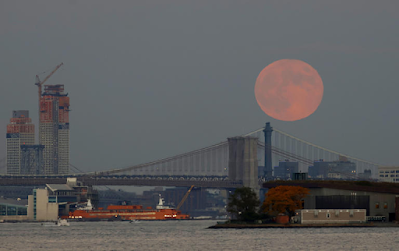

A Full Hunter's Moon rises above the Brooklyn Bridge &  Manhattan Bridge in New York City, USA on 28 October 2023, as seen from Jersey City, New Jersey.
Image by: Gary Hershorn/Getty Images

The Moon also influences the tilt of Earth’s rotation axis and how fast it wobbles. It is known as 'precession' in Applied Astrology.

Without the Moon, the Earth's wobble would be greater and change much more quickly.

The result would be far greater differences between the seasons and much greater variation in climate with latitude over evolutionary timescales.

Other than the usual upticks in violence and emotional reactions, it appears that the Moon indeed affects both man and beast.

The idea that the Moon impacts certain aspects of physical and mental health can be traced back to ancient Greece and Rome and is well-documented in the writings of classical authors like Aristotle and Lucilius.

For centuries, physicians and philosophers blamed behavioral changes on the pull of the Moon. The word 'lunatic' comes from the observations that changes in mental state were directly related to the Moon's phases.

For instance, famed British jurist William Blackstone wrote that people gained and lost their ability to reason according to the Moon’s shifting phases.

During the 1970s, psychiatrist Arnold Lieber theorized that the Moon changed the body’s biological tides and altered human behavior, leading to increased rates of violence and homicide.

One 2021 scientific study found that people fell asleep later during Full Moons and slept less overall on the nights before the full moon.

A 2015 study of 205 people found that the full moon may affect sleep differently in males and females.

Researchers found that many females slept less and have less REM sleep when the full moon phase is near, whereas males have more REM sleep closer and during a full moon.

Other research suggested that the full moon may be associated with less deep sleep and increased REM (rapid eye movement) latency.

Sleep latency is the period between when you first fall asleep and when you enter the first stage of REM sleep. So, increased latency means it takes a longer time to get to REM sleep.

Researchers have found that those with bipolar disorder may be affected by changes in the lunar cycle.


Specifically, a 2018 study examined 17 people whose bipolar disorder tended to switch rapidly from depression to mania.

The study showed that the circadian pacemaker (a small group of nerves) in these individuals became synchronized with lunar patterns.

It caused changes in their sleep that then triggered a shift from depression symptoms to mania symptoms.

In a 2019 case study of a woman with bipolar II disorder, researchers suggested that this Moon-mood connection can be treated by changing some medications (especially thyroid medications and antidepressants) and using light therapy.

Those who want to know more and see other scientific studies, please see The Lunar Cycle: effects on human and animal behavior and physiology.


Bright Comet Races Across Earth’s Skies

"Like a comet burn'd,
That fires the length of Ophiuchus huge
In the arctic sky, and from his horrid hair
Shakes pestilence and war." 

~ Milton


by Theodore White, mundane Astrolog.sci

In Astrometeorology and Mundane Astrology, there are said to be foreshadowing and previous celestial events such as comets that presage later major events to follow.

I have forecast many events over the course of my forecasting life as an astromet and mundane astrologer, however, this science and art has been with us since the dawn of humanity.

In this early era of global cooling, as the Sun heads deeper into quiescent solar cycle #25 and into its soon-to-be Grand Minimum, the solar, lunar, planetary and yes, even stellar signs point to a very active decade of the 2020s, 2030s, 2040s and even the 2050s.

The presages, portents and signs of comets, historic planetary conjunctions and of course, eclipses of the Sun and Moon have shown to me that we are in very interesting and to some, very dangerous and challenges times ahead.

Comet A3 (Tsuchinshan-ATLAS) on 15 October 2024 over Slovakia by moonlight
Image by: Petr Horálek

People from around the northern and southern hemispheres have been taking pictures of the "comet of the century" - which has been observed streaking across the skies after sunset.

Comet A3 (Tsuchinshan-ATLAS) was seen in September 2024 from Earth for the first time since the Neanderthals were alive.

 Like Earth, the Solar and Heliospheric Observatory (SOHO) crossed the orbital plane of Comet Tsuchinshan-ATLAS on Oct. 14, 2024.

This captured image from the spacecraft's coronagraph shows what happened:


The diagonal band of light is comet dust scattering sunlight into the coronagraph's camera.

When SOHO crosses the orbital plane, the band shrinks into an exquisitely thin line.

It is like piloting a spacecraft through the rings of Saturn and seeing them edge-on. Something similar occured to SOHO.


Comet Tsuchinshan-ATLAS, or C/2023 A3, was first detected in 9 January 2023 by the Tsuchinshan Observatory in China and by the ATLAS (Asteroid Terrestrial-impact Last Alert System) telescope in South Africa - where it got its name.

What happened was that on February 22, 2023, the ATLAS telescope in South Africa detected a new faint object that was proven to be a comet.

It was temporarily designated as A10SVYR.

The comet was also independently captured by a telescope at Purple Mountain Observatory (Zijinshan Astronomical Observatory) on January 9, 2023.

It was added to the list of objects awaiting confirmation, but after no follow-up observations were reported, it was removed on January 30, 2023, and was considered lost.

Based on the comet naming system, the comet received the names of both observatories and was officially named C/2023 A3 (Tsuchinshan-ATLAS).

Originating from the Oort Cloud, which is a large shell of icy debris in outer solar space, the comet, primarily made of dust, ice, and rock, was last seen in the Southern Hemisphere and Tropics until October 8, 2024.

Visibility in the Northern Hemisphere peaked on October 12, but the comet and its long dust tail will remain seeable until October 21. However, the comet will fade over time as it moves farther from the Earth.

click on graphic to enlarge

Here is a plot for the visibility of C/2023 A3 (Tsuchinshan-ATLAS) in the coming weeks.

The lower the magnitude, the brighter the comet appears. The brightest objects have negative magnitude values.

October 14-20: from 0.5 to 1.7 magnitude, the comet is losing brightness, but is moving farther from the Sun and therefore easier to see.

The comet will be visible with the naked eye in the evening about an hour after sunset.

You can also see the comet's 'anti-tail' which is a bright streak that appears to be pointing toward the Sun, opposite the other tails.

By October 15th, the comet will pass 1.4° from the M5 globular cluster, providing a good photo opportunity as it passes through the constellation of Serpens Caput.

October 20-31: the comet goes from 1.9 to 3.9 magnitude as moves across the constellation Ophiuchus relatively high in the southwestern sky in the evening.

You can use with binoculars and telescopes. During those days (Oct. 20-31st) the tail of the comet will be seen to rapidly grow.

November 2024: the comet goes from 4 to 8 magnitude but is still visible in the evening. It will rise higher in the Northern Hemisphere after sunset.

December 2024: Comet C/2023 A3 Tsuchinshan-ATLAS goes from 8 to 10 magnitude, as it gradually moves closer to the Sun in our sky but rising lower above the horizon. It will not be visible from the Southern Hemisphere.

See for yourself. The comet comes out of the twilight about 45 minutes after your local sunset.

It is easy to find using binoculars and, then, once you find it, is easy to see with the unaided eye.

The comet's long tail stretches more than 10 degrees above the western horizon, remaining visible in the moonlight for as much as an hour after the head of the comet sets.

There is an 'anti-tail' of the comet emerging from the comet's head.

Comet C/2023 A3 Tsuchinshan-ATLAS is now well visible low above the western horizon just after sunset for observers in the Northern Hemisphere.

While the comet is still close to the Sun, it will gradually move farther away throughout the week, making it easier to spot.

Although it will lose brightness, your chances of seeing the comet will improve. It’s visible to the naked eye, but a pair of 10x50 binoculars will give you an even better view.

In the Southern Hemisphere, the comet remains closer to the Sun, but visibility will improve with each passing day.

Around October 16-17, 2024, observers in southern latitudes should be able to see Comet Tsuchinshan-ATLAS as its apparent distance from the Sun will increase. 

See it in this amazing capture of Comet Tsuchinshan-ATLAS from Lorenzo Comolli of Sicily, Italy, that was taken on 14 October 2024.

click on image to enlarge
Comet Tsuchinshan-ATLAS - 14 October 2024 from Sicily, Italy
Image by: Lorenzo Comolli

A number of British stargazers said they had spotted the comet on Saturday, October 12, 2024, after the Royal Astronomical Society (RAS) predicted it might be visible to the naked eye.

click on image to enlarge
London, England - Arash Sefidgaran said: "Finally after weeks of waiting for the Tsuchinshan-ATLAS comet to be visible at higher latitudes like London, I managed to view and capture this stunning sight today, 12 October 2024."
Image by: Arash Sefidgaran

Comet Tsuchinshan-ATLAS came within about 70 million km (44 million miles) of Earth on October 12, 2024.

The comet will be visible in the northern hemisphere through to 30 October 2024 - and will easily been seen over North America.

A second tail of the comet - called the ion tail - may be faintly observed. Some have dubbed the spectacle the “Comet of the Century” due to its recurrence time frame.

Stargazers can look west between Venus and Arcturus about 30 to 45 minutes after sunset to view the comet.

click on image to enlarge
The comet was also visible in South Carolina, USA, shortly after sunset local time, in the western sky over the Lake Murray Dam Hydroelectric Intake Towers near Columbia on October 12, 2024
Image by: Reuters

Comet Tsuchinshan-ATLAS was also photographed in Spain, Italy, Uruguay, and Indonesia from late September to early October, when it was visible in the southern hemisphere.

Comet Tsuchinshan-ATLAS before dawn on 29 September 2024 from Mount Bromo in East Java, Indonesia.
Image by: Getty Images

In Mundane Astrology, comets are nearly always seen a malefic portents of things to come and there is another comet possibly on the way for late October and into November 2024.

Cycles of solar, lunar, planetary and stellar events are used in my mundane charts for determining the future of world events and trends.

The Bible itself refers to changes or new appearances in the heavens that were the harbingers of either calamities and/or a new order of things.

For instance, in a catalog of pestilences since the Christian era began, it was shown in the Atmospherical Origin of Epidemical Diseases by medical doctor T. Foster (1809) that it was discovered that on 262 occasions the appearance of comets coincided very closely.

In Mundane Astrology, comets are associated with the births and deaths of important individuals; and also presages on geopolitical and geophysical events.

Comets appearing in the eastern quarter of the skies generally bring about events quickly while in the west can manifest slower and often extend as long as three years. 

The effects on weather and climate can be a drier atmosphere to that over longer spans to condense the aqueous vapors.

By the time of the perigee 'Supermoon' on Thursday, October 17, 2024, Comet Tsuchinshan-ATLAS will be at the foot of the constellation Virgo.

click on graphic to enlarge

The quarter of the heavens among the constellations where the comet appears can show the part of the world on which the comet's effects will primarily fall, that is the Sign of the Zodiac and the particular nation, government and/or kingdom governed by that Sign.

In Mundane Astrology, the countries, cities and towns ruled by Virgo are:

Syria, Brazil, Crete, Turkey, Thessaly, Croatia, Greece, Mesopotamia, from the Tigris to Euphrates, also Silesia, Switzerland, the state of Virginia and also the West Indies.

Cities and towns also ruled by Virgo are:

Jerusalem, Bury, Cheltenham, Maidstone, Norwich, Reading, Todmorden, Boston, Massachusetts, Brindisi, Corinth, Heidelberg, Lyons, Paris, Padua, Strasburg, Toulouse and Los Angeles, California.

By mundane empirical law, when a great comet appears in the skies, we may deduct that outstanding events will sure enough soon follow.

Copyright © 2007-2024 Theodore White

Excerpts may be republished with attribution in the body of the material. 

Please include the Global Astrology link to your site.

Tuesday, September 17, 2024

Signs of the Times >> Super Perigee Moon, Lunar Eclipse: Signs, Storms, Floods & Earthquakes >> Use Caution From September 2024 to June 2025 >> Plus, Nova Explosion in Corona Borealis Expected Soon >> The Northern Crown: Troubles Ahead in the United Kingdom?

 Signs of the Times

Super Perigee Moon & Lunar Eclipse Ahead

‘Storms, Floods & Earthquakes'

Urge Caution During Mid-September, Early October 2024

Local residents rescue a man from rising floodwaters in the Romanian village of Slobozia Conachi over the weekend of 14-15 September 2024.

Plus,

Nova Explosion in Corona Borealis Expected Soon


Plus,

Troubles Ahead in the United Kingdom?

THE NORTHERN CROWN:
'HISTORY OF CORONA BOREALIS’


GLOBAL ASTROLOGY

by Theodore White, mundane Astrolog.sci


In this edition of Global Astrology, I continue to examine the eclipse seasons of 2024 and the planetary transits and influences to come.

The good reader will notice headline news events - often of a shocking nature - come to the forefront as geophysical events as well make headlines, especially disasters such as storms floods, wildfires and earthquakes, which I presage due to celestial astrophysical causes.

We are living in times that continue to warn humanity that it must evolve favorably, or face the consequences malefically.

I prefer to forecast presages of significant events in our time through their celestial and planetary configurations and transits – now is another one of those times.

Another rare coincidence of the partial Lunar Eclipse with a perigee Supermoon that will fill the skies across the northern hemisphere on Tuesday, September 17th is that it should coincide with multiple man-made and natural events that make major headlines.

And on the night of 17-18 September, the Earth will cast its shadow across the lunar surface, partially shining blood red, as a full perigee Moon will follow starting the Full Lunar Week of Sept. 17th to Sept. 24th.

World transits, those of the Sun, Moon, planets and stars, also show that the second half of 2024 and first half of 2025 will be significant in the lives of many tens of millions of people.

Strong geophysical (and metaphysical) events such as powerful storms, earthquakes and volcanic eruptions are presaged as we near the northern hemisphere’s Autumn Equinox of mid-September.

I advise caution as atmospheric-related events, including seismic activity will increase. The good reader who knows this now can immediately refresh their emergency supplies and review their emergency preparedness.

We are approaching a lunar eclipse and Earthquake season with the planetary transits to come through September and into autumn season.

I expect to hear news events of various storms, floods and powerful earthquakes from September 2024 into early 2025.

I urge caution for the good reader who lives in seismically active zones - even regions where earthquakes are rare will tend to react seismically due to solar, lunar and planetary causes.

On the financial markets, there are indications to this mundane astrologer that corrections are coming in the wake of the lunar eclipse over New City:

SuperMoon Partial Eclipse

Tuesday, 17 September 2024

New York, NY


click on chart to enlarge

The financial markets are set for a series of corrections according to my astrological calculations. 

I advise investors and traders to be wary of excessive trades and to be mindful of the medium and longer-term future while understanding the needs of the present.

It is always wise to know your own personal transits an progressions going forward into the second half of 2024.

Times are indeed changing as the post-pandemic era enters the mid-2020s, says Barry Ritholtz, co-founder, chairman and chief investment officer of Ritholtz Wealth Management LLC. 

As the month of October 2024 nears, Ritholtz comments:

"If ever a week was ripe for delaying your return to the office, it was this one.

Hurricane Idalia cleared out the weather up and down the coast, bringing two weeks of clear blue skies and decent surfing (and dangerous rip tides.)

Then, a heat wave hit the East Coast, raising temperatures to the 90s in New York City.

You could have continued your Endless Summer, working remotely in the AM, sneaking out for a few hours of mid-day beach fun, then returning home post-surf to respond to emails and other work-related detritus.

And yet, the city was jam-packed this week. Streets were filled, restaurants booked, traffic busy, and even offices seemed to have a marked increase in the number of bodies filling the hallways.

Lots of major employers in the New York City area have put a flag in the ground: October 1st.

That seems to be the drop dead date for when many companies will require employees to be back at least three, sometimes four and five days per week.

My frame of reference is finance, and so seeing these requirements in places like JP Morgan Chase - which has abandoned its hybrid attendance policy for 5 days a week.

Bloomberg is 4 days (Oct 1); Citi and Wells Fargo are 3 days a week, Black Rock four days, Goldman Sachs and Morgan Stanley join JPM at five.

But it’s not just finance:

Federal workers have been ordered back to their offices.

Amazon, Apple and Google are at 3 days/week; Salesforce is three days a week in the office and four days for client-facing employees.

Even Zoom is requiring in-person work.

Resume Builder notes: “A whopping 90% of companies plan to implement return-to-office policies by the end of 2024.”

According to Build Remote (not exactly an unbiased source) 21% of the Fortune 100 require three office visits per week with 77% operating on a hybrid work schedule.

click on graphic to enlarge

All of these add up to the inescapable conclusion that the era of freewheeling “come in whenever the hell you like...” is coming to an end.

Of course, there are a few wild cards here. There’s been an uptick in COVID infections albeit from a mild variant; new booster shots will be available later this month. But barring some new deadly variant surge, it’s unlikely that the endemic will remain a factor in return to office.

Small, nimble firms have been using WFH and flex hybrid schedules as a key selling point.

Indeed, recent data shows a 29% surge in Hybrid job listings. You can be a cog in some massive faceless machine, goes the pitch, or you can work for (fill in the blank) start-up and have a lot more flexibility when you go small instead of big.

Alas, that was a persuasive argument in 2021-22, but I suspect it might have lost some of its power over the past year.

Blame the Fed for the new stricter RTO policies.

It is not a coincidence that as higher rates have begun to bite - with impact on real estate, finance, and consumer spending - the economy has begun to soften.

New job creation is slowing, wage gains are moderating, and the balance of power is slowly shifting back to employers.

I personally have mixed feelings on this: I loved recapturing my commute time, but I also see how challenging it is to train and mentor younger employees and instill a strong sense of corporate culture.

Regardless, the Summer is coming to an end, and for many, the office is beckoning - for many of us, at least 3 days a week."

This observation by Ritholz comes as no surprise to this mundane astrologer as the world's lunar nodes will change in January 2025 which will open a very interesting mini-era into the middle years of this decade. 

Signs of the times.

As for those who do not want to open their eyes and minds to the realities of our world - all of it Astrology - I have this message in a song that is an appropriate message to the unbelievers.


Signs of the Times:

Super Perigee Moon & Partial Lunar Eclipse


by Theodore White, mundane Astrolog.sci


In Applied Astrology, the phases of eclipses are unique.

Often solar and lunar eclipses will have strong metaphysical and geophysical effects upon the Earth and its inhabitants.

See world news at this time of the full lunar perigee just before, during and after the Full Moon Week (Sept. 17-24) and with the partial eclipse, effects will linger into the month of October.

 There will be unusual floods, earthquakes, and storm activity in various regions of the world that are above normal, costing lives and property. Caution is urged.

On Tuesday and Wednesday (Sept, 17-18, 2024) there will be what is known in Astrometeorology as the 'Harvest Moon.’

It is simply the name given to the September full Moon that occurs closest to the autumn equinox, which takes place on Sept. 22 this year.

But this year's harvest moon is also going to be a 'Supermoon,' as well as a blood moon, and these particular set of celestial phenomena does not often take place together.

For it to be a Supermoon, the moon has to be at its perigee, which means the Moon is as close to the Earth as it can get during its orbit.


This causes the Moon to appear bigger and brighter than it normally would.

click on image to enlarge

There are three to four super moons a year, and they usually line up in a row. This year, the first supermoon was August’s rare blue supermoon.

September will be the second and we are on schedule to see supermoons in October and November as well.

The Full Moon will be on the evening of Tuesday, Sept. 17, and the morning of Wednesday, Sept. 18.

The weather and climate will be wetter than normal with preceding opposing bouts of dryness, drought and wildfires to torrents of heavy rains, followed quickly by deadly flash floods, particularly in towns and cities, urban areas, but also through rural interiors of countries. 


A perigee Moon that is a 'supermoon' will often increase the action in the Earth's atmosphere to a great extent where the weather makes world headlines - especially by means of water and fire.

I believe this will again be the case from mid-September onwards throughout much of the northern hemisphere.

click on graphic to enlarge

This is the weather of 'global cooling' and the decline of the Sun into its quiescent phase - its Grand Minimum - which I have been long been predicting for the 2020s, 2030s and 2040s.

I also caution again to be prepared for seismic activity through September and October 2024 as my calculations show that even strong moderate earthquakes will be felt as well as those of larger magnitude.

Take care to immediately update your emergency preparedness plans and supplies with your family, community and friends.


click on image to enlarge

If the good reader observes at the skies any night between September 16-20th then you will see the Moon that is about 90 percent until the Full Moon is exact will show you a moon that is over 90% full.

The Moon is the easiest celestial body to find in the sky. It'll rise out of the eastern sky for everyone in the United States at around 7:50 p.m. EDT on the East Coast and around 7:10 p.m. Pacific Time on the West Coast.

While you're looking up at the sky; also keep an eye out for T Coronae Borealis, a white dwarf star that is set to go nova any time now and will show up as a new star in the night skies for a while. More on that below.

Blood moons are caused by lunar eclipses, and one will be taking place on the evening of Sept. 17th.

The partial eclipse should be visible to the entire continental US, although the time of day and weather conditions will vary depending on where you are.

On the East Coast, the eclipse will start at around 8:41 p.m., reach its maximum at 10:44 p.m. and then end by 12:47 a.m. eastern daylight time.

On the West Coast, the partial eclipses will begin at around 7:12 p.m., just as the Moon rises over the Ascendant.

The Moon will reach its maximum at 7:44 p.m. and then finish up by 9:47 p.m. for western viewers. You can add or subtract an hour depending on your time zone to know when it'll hit you.

Observers will see a sliver of the near full Moon disappear briefly before coming back. The eclipse will affect the Moon's color more than how well you can see it.

None of the individual components of the super harvest blood moon are rare as Harvest moons take place every year, and Supermoons can occur three to four times a year and red blood-colored moons also be seen a few times every year.

However, having all three events line up at the same time is unusual and so there will be unusual events and weather.

Therefore, I have noted three (3) degrees of Pisces that the eclipsed Moon will shed its light:

The partial eclipse is in the 25th and 26th and 27th degrees of tropical Pisces and are described by the astrologer Sepharial:

25-Pisces: A crown through which is set an upright swordIt is the index of a mind set upon high resolves and capable of sustaining the assaults of its enemies in such a degree as to achieve its purposes without loss of fortune, prestige or honor. Such a one may prove to be a great warrior, a man of the sword, to whom honors will be given without stint.

A king, he will sustain his throne by the use of aggressive measures and by victories gained over all his enemies; while one of lowly birth will gain his crown in the service of his king. His mind will be upright, astute, aspiring and sustained by an unswerving faith, it is a degree of VICTORY.

26-Pisces: A man in armor, fully equipped and bearingThis indicates one who will walk through life warily but with that assurance which is the result of being forearmed against danger.

While cautious and circumspect, he will show a brave and dauntless spirit and with the double equipment of caution in defense and courage in attack, he will surmount the machinations of his enemies and break down all opposition.

Such a one will be faithful in his dealings and just to his fellows, so that he will abide in safety, defended at all points by the goodwill of his friends and the faith of his associates. It is a degree of SECURITY.

The partial eclipse will continue to affect the following degree of 27-Pisces which is close to where the Earth will transit on the 20th and 21st of September 2024 and calls for attention as transiting Neptune is close to the fatal star of Scheat.

27th degree An earthquake. – This is a sinister indication and can refer to one who will be overcome by sudden and unexpected calamities, which will undermine his labors and reduce his hopes to ruin.

Let him be careful where he builds, and test with discernment and understanding the grounds of his faith and hope in others. Let him labor diligently and sow in the broad valleys of the world the seeds of his yet uncertain harvest.

For the rest, let him trust in Heaven and invoke its aid in all humility. But, if he should aspire to build his castles of many stages, or spread his vineyards up the mountainside, then he shall have the greater need of care and stronger faith in God, himself and man. It is a degree of REVERSAL.

These degrees, in light of the associated planetary transits now underway, and those to come in October, November and December 2024 and into January, February and March 2025 call for keen attention to the storms and floods, powerful seismic activity, the financial markets, local, regional, national politics and geopolitical affairs globally.

The regions are primarily in the northern hemisphere and features Europe, parts of Asia and the Middle East, and North America.

These planetary transits have been active since late June 2024 that are now expressing strong influence in September and October 2024 will continue through the first half of 2025.

My mundane calculations show these these are the important planetary signatures having the strongest effects during the second half of 2024 and into the first half of 2025.

Those who want to know how these world transits will affect them personally and professionally, or how their family, and communities will be impacted can contact me at astro730@gmail.com

When you write, please include your birthday, time of birth (if known, but can be rectified) and your city, town and country of birth.

Include any comments and questions on your aspirations, goals and plans for the next 3-5 years on how your transits, directions and progressions via your birth horoscope will play out and what you can do to make them favorable for you.


Planetary Configurations & Signatures Impacting the World:


Calculations by Theodore White, mundane Astrolog.sci


These are the planetary signatures, configurations and aspects relative to the Earth that I have determined are more fully impacting us at this time in history.


  June 29, 2024 – SATURN RETROGRADE AT 19-PISCES

·        July 2, 2024 – NEPTUNE RETROGRADE AT 29-PISCES

·        August 5, 2024 – MERCURY RETROGRADE AT 4-VIRGO


·        August 7, 2024 – JUPITER SESQUI QUADRATE PLUTO

·        August 19, 2024 – JUPITER SQUARE SATURN (first of three world aspect squares)

·        August 28, 2024 – MERCURY DIRECT AT 21-LEO

·        August 31, 2024 – VENUS HEADS SOUTH IN DECLINATION


·        September 1, 2024 – URANUS RETROGRADE AT 27-TAURUS

·        September 18, 2024 - PARTIAL LUNAR ECLIPSE AT 25-PISCES

·        September 26, 2024 – SATURN SEMI SQUARE PLUTO (2nd exact world semi-square)


·        September 28, 2024 – MERCURY HEADS SOUTH IN DECLINATION

·        October 2, 2024 – ANNULAR SOLAR ECLIPSE AT 10-LIBRA

·        October 9, 2024 – JUPITER RETROGRADE AT 21-GEMINI 

·        October 12, 2024 – PLUTO DIRECT AT 29-CAPRICORN

November 15, 2024 – SATURN DIRECT AT 12-PISCES

·        November 26, 2024 – MERCURY RETROGRADE AT 22-SAGITTARIUS


·        December 6, 2024 – MARS RETROGRADE AT 6-LEO (until February 23-24, 2025)

·        December 7, 2024 – NEPTUNE DIRECT AT 27-PISCES

·        December 13, 2024 – JUPITER SESQUI QUADRATE PLUTO


·        December 15, 2024 – MERCURY DIRECT AT 6-SAGITTARIUS

·        December 24, 2024 – JUPITER SQUARE SATURN (2nd of 3 world squares)


·        January 26, 2025 – SATURN SEMI SQUARE PLUTO (3rd exact world semi square)

·        January 30, 2025 – VENUS HEADS NORTH IN DECLINATION

·        January 30, 2025 – URANUS STATIONS DIRECT AT 23-TAURUS


·        February 4, 2025 – JUPITER STATIONS DIRECT AT 11-GEMINI

·        February 24, 2025 – MARS STATIONS DIRECT AT 17-CANCER


·        March 2, 2025 – MERCURY TURNS NORTH IN DECLINATION

·        March 2, 2025 – VENUS RETROGRADE AT 2-ARIES

·        March 15, 2025 – MERCURY STATIONS RETROGRADE AT 9-ARIES

·        April 3, 2025 – MERCURY TURNS SOUTH IN DECLINATION


·        April 4, 2025 – SATURN SEXTILE URANUS 1st of three sextile aspects)

·        April 7, 2025 – MERCURY STATIONS DIRECT AT 26-PISCES

·        April 13, 2025 – VENUS STATIONS DIRECT AT 24-PISCES


·        April 17, 2025 – JUPITER SESQUI QUADRATE PLUTO

·        April 23, 2025 – MERCURY TURNS NORTH IN DECLINATION

·        May 4, 2025 – PLUTO STATIONS RETROGRADE AT 3-AQUARIUS

·        June 4, 2025 – JUPITER SEMI-SEXTILE URANUS

·        June 15, 2025 – JUPITER SQUARE SATURN (3rd and final world square)

·        June 19, 2025 – JUPITER SQUARE NEPTUNE


Again, I urge caution and advise against extensive travel if it can be helped as the planetary signatures relative to Earth from mid-September 2024 onward into June 2025 are significant.

Meanwhile, as the geophysical events from the Supermoon and partial lunar eclipse take place, also know that a white dwarf star is about to go nova in the constellation of Corona Borealis, the Northern Crown.

It will appear as a new star in the heavens for a time before it burns out and you will be able to see it with your own eyes.


Nova Explosion in Corona Borealis Expected

'Blaze Star Imminent


by Theodore White, mundane Astrolog.sci


A recurring nova star, called ‘T Coronae Borealis,’ which periodically mutates into an earth-size hydrogen bomb, is expected to do so between September and early winter 2025.

When it explodes, it will be bright enough to see with the naked eye, but the nova, when it occurs, it will also burn out in less than a week.

When T Coronae Borealis explodes, the white dwarf will brighten over about five days, reaching a brightness to that of the North Star.

It will be visible to the naked eye for several hours and then gradually dim over the following weeks. But, about five days after the peak, you should still be able to see it with binoculars.

Interestingly, T Coronae Borealis is unique because it brightens again about 100 days after the initial explosion.

The second brightening won’t be visible to the naked eye, but astronomers with powerful telescopes will be able to study it in detail.

The white dwarf star that is set to go nova any day now and will show up as a new star in the sky for a while.

Formed in an semi-circle, Corona Borealis has nine principal stars.

The extreme northern star is Theta; then the stars follow in order: Beta, Alpha, Gamma, Delta, Epsilon, Iota – all in an almost perfect semicircle 20° northeast of the star Arcturus.

The best way to find Corona Borealis is to look for the stars Vega and Arcturus, which are among the two brightest stars in the Northern Hemisphere.

Then, draw an imaginary line between the two and you will see the constellation Corona Borealis is nearly right in the middle.

Corona Borealis is between the constellations of Hercules and Bootes. However, you will not be able to see the star in Corona Borealis until the star goes nova. 

The last nova from T Coronae Borealis was in solar year 1946, and before that, back in 1866.

Due to the celestial pattern, it explodes every 80 years, that means another explosion is coming soon.

Before each of these past explosions, the white dwarf has gone through distinct phases.

About 10 years before the explosion, the star system tends to brighten up - likely because the disk is becoming more active and funneling more material onto the white dwarf.

T Coronae Borealis did brighten again during the 2010s - just as it did before the previous explosions.

Also, about a year before each explosion, the white dwarf dims.

This dimming started again in March 2023, leading us to believe that the next explosion could happen any time within the next few months.


click on image to enlarge

To see the nova with the naked eye, just follow the tail of the Big Dipper. That will lead you to Arcturus, one of the brightest stars in the sky.

Just to the east of Arcturus is the constellation of Corona Borealis, which T CrB is a will explode. 

The impending nova of T CrB will be seen just below the apex of the constellation semicircle of a curved crown of stars, again, it will be visible to the naked eye.

See ->> https://www.youtube.com/watch?v=WMzRm05nxik

Astronomers know the nova has already occurred because it takes place about once every 80 years. 
The ‘Blaze Star’ itself, called ‘T CrB’ has suffered a signature loss in its star power that has preceded previous cataclysms.

The self-destructing supernova was last observed in February 1946, and before that, in May 1866.

A sharp-eyed, sky-conscious reader submitted this letter to the editor of the Detroit Free Press in May 1866. The Free Press ran it on its front page.

Historical accounts say that a German priest, Abbott Burchard of Upsberg, sighted the star in Corona Borealis going nova in the year 1217:

The priest described it as “a faint star that for a time shone with great light.”

There are also accounts from the era of the Middle Ages from Chinese and Korean stargazers who easily observed the nova explosion as well.

The star to go nova anytime between September 2024 and early 2025 is 3,000 light years from Earth.

Light travels about 5.9 trillion miles annually. So, multiply 3,000 by 5.9 trillion – as in comparison, the light from the Sun – some 93 million miles from us – reaches the Earth in about six minutes.


In Corona Borealis, this stars' nearest neighbor is a gigantic, gaseous nuisance. The nova I am describing is a ‘white dwarf,’ which is the lesser half of a binary system where two stars are bound together by gravity.

Its partner is a ‘red giant’ that leaks hydrogen because its gravity cannot hold it all.

Eventually, it is lured by the gravitational system of its partner, the white dwarf nova – which in Latin means “new,” as in new star.

The white dwarf is an Earth-sized core of a dead star that is unimaginably hot – easily exceeding 180,000 degrees Fahrenheit, by NASA’s estimate.

A white dwarf orbiting a red giant star
Image: NASA


So, when enough hydrogen accumulates on the white dwarf, the result is a nuclear explosion that NASA says is 10 times stronger than the annual output of the Sun and very 80 years, the white dwarf has accreted enough mass that it explodes and T CrB becomes visible to Earth.

There are a few reasons why T Coronae Borealis is particularly interesting. First, it’s the closest of all the recurrent novae, located only about 2,600 light-years away.

This proximity allows us to study it in greater detail than other similar systems. Since it erupts relatively frequently, we can also predict when it will happen and prepare for it.

T Coronae Borealis is also intriguing because its white dwarf is close to the maximum mass that a white dwarf can have, known as the Chandrasekhar limit.

If a white dwarf exceeds this limit, it can collapse and trigger a much larger explosion called a Type Ia supernova.

These supernovae are critical for understanding the universe because they produce many of the heavy elements necessary for life and serve as important tools for measuring cosmic distances.

In recent years, astronomers have discovered that novae can emit high-energy gamma rays, something that was unexpected.

These emissions are likely caused by shocks created when the exploding material from the white dwarf interacts with the surrounding material from the red giant. So, closely watching for the nova of T Coronae Borealis to come will also be an opportunity to study the gamma-ray emissions.

These celestial events are all part and parcel of the presages for humanity as we enter into the middle years of this decade. 

The weather and climate will continue to play an ever increasing role as the cultural, social, political and geopolitical affairs of humanity become more challenging.

It is best to mind the signs of the times and the planetary transits to understand clearly what you are facing as we near the mid-to-late 2020s and into the 2030s.


Troubles Ahead in the United Kingdom?

THE NORTHERN CROWN:
'HISTORY OF CORONA BOREALIS’


by Theodore White, mundane Astrolog.sci

Since the global pandemic of 2019-2021, the world has been in a post-pandemic era since 2022 and continues to feel the consequences of the the COVID-19 spread.

In world society, these effects have also lingered into politics and nowhere is this more evident than in the United States and Great Britain - where ideology has worked to divide the populace who claim that 'globalist' force have infiltrated their nations and turned the western lifestyle in a state of disarray and decline. 

A spectacular event, the nova of a star in the constellation of Corona Borealis is about to take place in one of first constellations I studied as a student of applied astrology.

The astronomical history of the Northern Crown, Corona Borealis, may provide more insight into the events to come before, during and after the U.S. General Election.

This is especially so in light of the September 15, 2024 - the 2nd assassination attempt on President Donald Trump - after the 1st attempt in July 2024.

For the full history of Corona Borealis, see ->> https://www.constellationsofwords.com/corona-borealis/

Meanwhile, the United Kingdom is about to experience an era of challenges due to the coming return of Saturn in tropical Aries (2025-2028) according to my calculations.

The recent riots in Britain are signs of what is to come during strong planetary transits such as Saturn and Neptune in tropical Aries - especially Saturn's transit in Aries during the mid-2020s.

click on image to enlarge

In Mundane history, transiting Saturn is in its 'fall' in Aries and if you take a look at the last 700 years or so when it comes to England, there have been frequent misfortunes that have taken place with Saturn's sojourn in the cardinal fire sign.

Consider this:

In the year 1290, Saturn transited Aries and there was a war with the Scots that was waged by Edward the Third as the English army was beaten at Roslin near Edinburgh. 

In 1319, with Saturn in Aries, there was a rebellion under the Earls of Lancaster and Hereford. 

Then, in 1349, with Saturn again in tropical Aries, the Black Prince was defeated in France and died to great mourning of the nation.

Saturn was in Aries again in 1378 with the Wat Tyler Rebellion. 

In 1437, Saturn in Aries saw the English forces met with defeat after defeat in France, losing everything there but Calais.

Saturn transiting Aries again in solar year 1466 when civil war raged head by Warwick. 

Then, in the year 1555, Saturn, once again in tropical Aries during Queen Mary's reign saw some 277 people who were burnt at the stake.

In 1584, Saturn in Aries, a plot was discovered to assassinate Queen Elizabeth and 14 people were hung as a result.

Saturn again made transit in tropical Aries in 1643 when there was civil war between Charles I and the Parliament.

In 1761, Spain joined France in her war against England.

Then, in 1790, Saturn in Aries again saw war in India, riots at Birmingham amid national distress and violence.

By solar year 1820, Saturn against made transit in tropical Aries when the trial of Queen Caroline took place with the royalty disgraced and excitement in the streets of England.

Then, as Saturn made transit in Aries again over England in 1849 there was a spread of Asian cholera; economic depressions in trade values and a war in Punjaub.

Consider this as the United Kingdom is about to experience another transit of Saturn in tropical Aries during the mid-to-late 2020s:

From the United Kingdom, Nick Timothy writes that Britain must reindustrialize – or condemn itself to permanent decline.

He says, "every Labour government has left office with unemployment higher than when it began.

Keir Starmer says this time it will be different: that he is more interested in wealth creation than levying taxes.

Yet already we know this is untrue.

Government economic policy rests, supposedly, on industrial strategy – something often decried as 1970s corporatism, propping up failing companies, nationalising industries and outsourcing policy to the unions and corporations.

But just as there can be good and bad education or health policy, there is good and bad industrial strategy.

Good industrial strategy creates the conditions for market-led growth by aligning policies and public investment to maximise the bang for their buck.

Good industrial strategy aims to unleash competitive forces and innovation: through planning reform to get things built, energy policies to keep us competitive, infrastructure investment to improve transport and digital connectivity, education and training policies to give us the skills we need, and tax rules and regulations to encourage enterprise and investment.

For too often red tape stops getting things built and done.

All this should be backed by monetary and fiscal policies that provide stability, get us saving and investing more, and avoid perverse incentives, such as selling off promising businesses before they reach a critical size, or allowing strategically important industries to fall into distant, foreign hands.

The scale of businesses, and who controls them, matters more than orthodoxy suggests.

This is where even good industrial strategy can become contentious. For it requires the rejection of the laissez-faire policies beloved in the Treasury.

Our sustained trade deficit – which ballooned not under Margaret Thatcher, as often assumed, but Tony Blair – causes a vicious cycle of disinvestment and deindustrialisation.

Britain has brilliant research universities and a culture of enterprise, but the balance of our economy – over-reliant on services, with elites too casual about the loss of manufacturing – is all wrong.

While we need a stable long-term policy environment, the state should work closely with particular businesses. If JCB, for example, envisaged a supply chain cluster along the A50 in Staffordshire, we should be happy to designate a special zone, with lighter planning rules and investment incentives.

And we should always take an interest in who owns what.

As the Chinese owners of British Steel close the blast furnaces that make primary steel at Scunthorpe, they care nothing for the long-term consequences for the local community and for Britain.

Geopolitical change makes these questions more urgent. But we should anyway recognise that international trade has never been free nor fair.

When countries suppress labour costs, subsidise production, dump goods in our markets, and erect tariffs and other barriers to trade, we need to get real.

If we want our exporters to be competitive, we will in some sectors need to consider subsidies of our own and even, on occasion, tariffs.

The mass production of cheap Chinese electric vehicles, for example, will destroy Western capacity to manufacture our own, which is why we should be prepared to tax them.

Yet there is little such coherence to the Labour economic policy. Ministers blithely repeat lines such as “decarbonisation must never mean deindustrialisation”, but have no idea what this means in practice.

For the truth is that the Government is already set up to fail on the economy.

It plans to re-regulate the labour market, increasing the risk of employing new workers.

It plans to tax jobs, by putting up employers’ National Insurance contributions.

It is empowering the unions, by scrapping laws that regulate strikes and handing out inflation-busting pay rises in the public sector and on the railways.

Its spending choices mean more money for the unions, and less for investment in the technology that will make the public sector more efficient, and less for the infrastructure that will help the economy to grow.

The nationalisation of the railways will bring added costs, less funding and – looking at the publicly-owned Northern Rail, which cancelled up to 35 per cent of some services this summer – no improvement in services.

As the party of consensus and producer interest, the Government is already dismantling the education reforms that made English schools among the best in the world.

For school leavers, it is reversing the Tory policy to restrict the number of low-quality university courses, and looks set to increase tuition fees to £12,500 and liberalise the rules for student visas.

As a government driven by party politics, its housing targets prioritise not the cities – where demand is greatest and businesses need workers – but the green belt and countryside.

Policy is most confused when it comes to energy.

With the zealotry of a monomaniacal ideologue, the Energy Secretary Ed Miliband is banning oil and gas licences in the North Sea, and looks set to abandon the new nuclear plant at Wylfa in Wales.

His policy to decarbonize the National Grid in six years has been written off by experts as impossible and ruinously expensive.

Having promised to cut household energy bills by £300 a year, ministers have now gone quiet – because they know their policies mean prices are only going up.

The spectre of Milibandism haunts the whole economy.

At least partly because of net zero policies, ministers are unable to say if the domestic manufacture of primary steel should be treated as a strategic industry that must be protected and guaranteed.

Miliband’s ban on the import of coking coal anyway makes the question redundant.

Similarly, Britain is unlikely to impose tariffs on Chinese-made electric vehicles, not just because of Treasury orthodoxy – which promotes open trade with China even as that trade is used to eat Western productive capacity – but because Milibandism demands net zero whatever the cost.

No country got richer generating less electricity at higher cost.

But then no country has taxed its way to prosperity or achieved success by putting mass immigration before training its own people.

These are the reasons why Labour will fail, but the Conservatives need to adopt a more muscular economic policy. The state should be small, but it also needs to be smart, strong and strategic."

As we can see, the United Kingdom is also about to reach a critical crossroads going into the mid-2020s, especially with Saturn's coming transit in Tropical Aries and its conjunction with Neptune also in Aries starting in early 2025.


Copyright © 2007-2024 Theodore White

Excerpts may be republished with attribution in the body of the material. Please include the Global Astrology link to your site.